
Yoga for Seniors: Gentle Yoga Practices to Improve Mobility and Wellbeing
- Lisa Cox

- Mar 2
- 5 min read
Over the years, I’ve had the absolute joy of welcoming many older adults into my classes – some in their 60s, some well into their 70s and beyond. A lot of them arrive with the same worries: “Am I too old to start yoga?” or “I’m not flexible at all – will I be able to keep up?”
My answer is always the same: you are never too old to begin, and yoga can be adapted for every body.
In fact, yoga can be especially helpful as we get older. Gentle movement, conscious breathing and relaxation can support better mobility, balance, sleep and overall mood. In this blog, I’d love to share how yoga can benefit seniors, along with a few simple practices you can try at home.
Why Yoga Is So Supportive in Later Life
As we age, it’s completely natural to notice changes: joints feel a bit stiffer in the morning, balance isn’t quite what it used to be, and recovery after activity can take longer. The beautiful thing about yoga is that it meets you exactly where you are.

Some key benefits for seniors include:
Improved mobility and flexibility in the joints
Better balance, which can help reduce the risk of falls
Gentle strengthening of muscles that support posture
Easier, deeper breathing
A calmer mind and reduced feelings of anxiety or low mood
A sense of community and connection if practising in a group
You don’t need to twist into complicated shapes or get down on the floor if that doesn’t feel right for you. There are many ways to practise yoga – including seated and supported options – that are both safe and effective.
Gentle Practice 1: Seated Neck and Shoulder Release
Many older students tell me their neck and shoulders feel tight, especially if they spend time reading, watching TV or on the computer. This simple seated sequence can help ease that tension.
You can do this on a sturdy chair:
Sit tall with both feet flat on the floor, hands resting on your thighs.
Gently lengthen your spine, imagining a string lifting the crown of your head.
On an exhale, let your right ear fall towards your right shoulder (no forcing).
Breathe there for 3–5 slow breaths, feeling the stretch along the left side of the neck.
Inhale back to centre, then repeat to the other side.
For the shoulders:
Inhale and gently roll both shoulders up towards your ears.
Exhale and roll them back and down.
Repeat 5–8 times, moving slowly and smoothly.
These small movements, done regularly, can make a noticeable difference to comfort and posture.
Gentle Practice 2: Seated Cat–Cow for the Spine
A healthy spine loves to move. This seated version of the classic Cat–Cow is kind to the back but very effective.
Sit towards the front of your chair, feet flat on the floor, hands on your thighs.
As you inhale, gently arch your back, lift your chest and look slightly up – this is your “Cow” shape.
As you exhale, softly round your back, tuck your chin towards your chest and let your shoulders come forward – this is your “Cat” shape.
Move slowly between these two for 6–10 breaths.
Only go as far as feels comfortable. Think of it as oiling the spine rather than forcing a big stretch. Many of my senior students say this becomes a favourite morning ritual.
Gentle Practice 3: Supported Standing Balance (Holding a Chair)
Balance often becomes a concern as we age, and yoga offers a safe way to practise it. Always work within your comfort zone, and make sure you have something stable to hold on to.
Stand behind a sturdy chair, holding the back with one or both hands.
Place your feet hip-width apart and feel the ground underneath you.
Shift your weight gently onto your right foot and, if it feels safe, lift your left heel or the whole left foot just a little off the floor.
Keep breathing, focusing your gaze on something steady in front of you.
Hold for 3–5 breaths, then lower the foot and switch sides.
You don’t need to lift the leg high – even a small shift of weight can help train the muscles and the nervous system. Over time, you may find your confidence and stability improving.
Gentle Practice 4: Relaxing Breath to Calm the Mind

Stress and worry don’t magically disappear when we get older. In some ways, life’s challenges simply change shape. One of the most powerful tools I share with all my students – and especially seniors – is a simple calming breath.
Try this:
Sit or lie in a comfortable position, with your body supported.
Inhale gently through the nose for a slow count of 4.
Exhale softly through the nose for a slow count of 6.
Repeat for 8–10 rounds.
If counting doesn’t suit you, simply keep the exhale a little longer than the inhale. This signals to the body that it is safe to relax. It can be particularly helpful before bed or when the mind feels busy.
Listening to Your Body (And Trusting It)
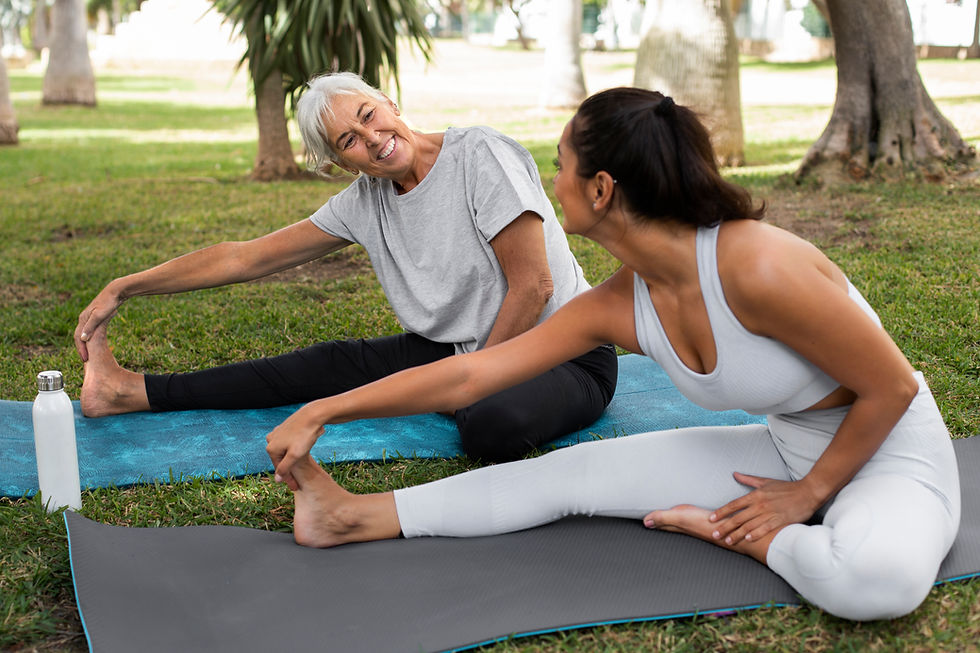
One thing I love about working with older adults is the natural wisdom you already carry. You know your body. You know when something doesn’t feel quite right. In yoga, that inner listening is incredibly important.
A few gentle guidelines:
Move slowly and mindfully; there is never any rush.
Nothing should be painful. If it hurts, ease out or stop.
Use props, cushions, blankets, blocks, and a chair to support yourself.
Tell your teacher about any medical conditions, joint replacements or operations so we can adapt things for you.
Yoga is not about keeping up with anyone else in the room. It is a personal practice, and each person’s version of a posture is beautifully valid.
You’re Never “Too Old” for Yoga
I’ve had students tell me, “I wish I’d started yoga 30 years ago.” While I understand the feeling, I always remind them: the best time is simply now. Even a small, gentle practice once or twice a week can have a wonderful effect on how you move and how you feel.
For seniors, yoga can be:
A way to stay more independent and mobile
A way to manage stiffness and aches
A way to find calm and companionship
A way to feel more at home in your own body
If you’re curious but nervous about joining a class, you might like to start with a private session or a slower, gentle group class where poses can be adapted for you. You will be welcomed exactly as you are.
If you’d like to explore gentle yoga for seniors in a safe, supportive environment, I’d be honoured to guide you. Whether you join me on the mat or on a chair, in person or online, we can take it one breath and one simple movement at a time.


Comments